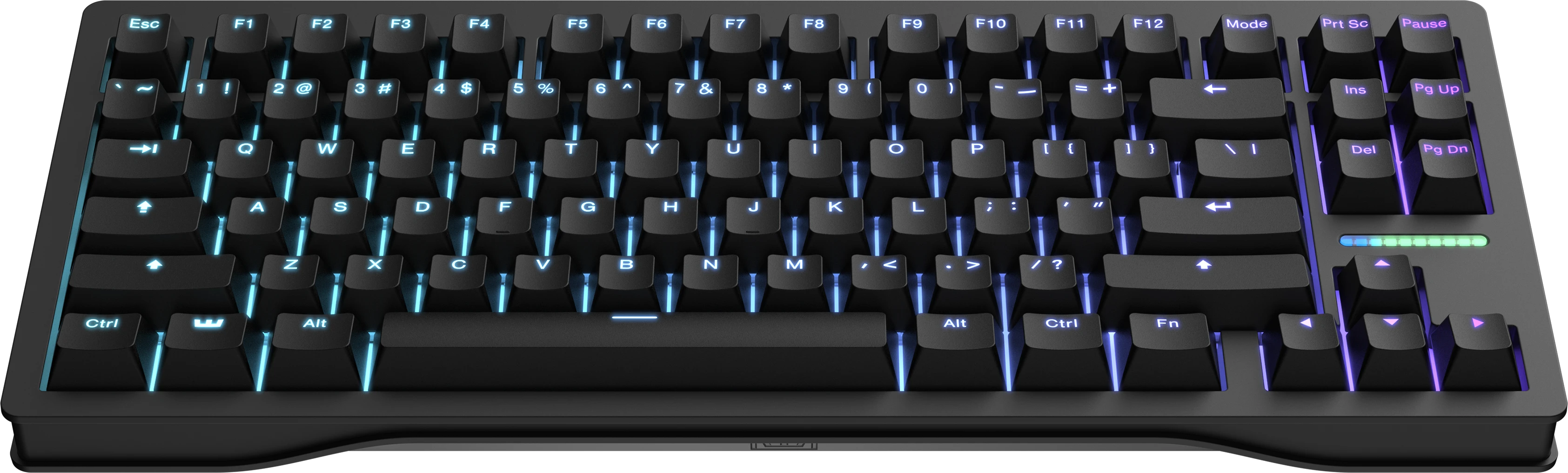
Wooting 80HE
The claim: The Wooting 80HE has true 8kHz polling, scanning every key at 8,000Hz rather than just reporting at that rate.
by Wooting
◐ Mixed evidence · Well sourced (6 sources)
By PixPause Editorial · 2 min read · Verified September 22, 2026
Partly — the 80HE's true 8kHz per-key polling is a real, independently confirmed technical feature, but the exact 0.125ms latency figure isn't independently re-measured in available reviews, and perception research suggests most players couldn't feel a difference that small anyway.
Make your guess on the slip to reveal the answer- "The Wooting 80HE has true 8kHz polling, scanning every key at 8,000Hz rather than just reporting at that rate."✓ HOLDS
- "0.125ms input latency gives players a meaningful, perceptible competitive advantage."◐ PARTLY TRUE
BUYING THE HYPE
▸ HYPE VS REALITY
Wooting markets the 80HE as 'our fastest keyboard to date,' advertising 0.125ms input latency and 'true' 8kHz polling — meaning every key is scanned 8,000 times per second, not just the USB report rate — as a meaningful competitive edge for gaming.
Wooting's engineering claim checks out on the parts that are independently checkable: the 80HE's Hall-effect switches and analog sensing hardware genuinely support true 8kHz per-key polling, a real technical distinction from keyboards that only claim a higher USB report rate without scanning every key that fast — PC Gamer's review confirmed the keyboard is 'fully wired for zero-latency input' with the 8000Hz polling working as described. But independent, methodologically transparent confirmation of the exact 0.125ms figure is thin; reviews like GeekKeyboard's largely restate Wooting's own number rather than independently measuring it. Separately, research on human input-lag perception summarized by keyboard-latency explainer site MKBGuide finds people reliably detect delays only above roughly 20-30ms, meaning the practical, feel-the-difference impact of shaving response time into fractions of a millisecond is disputed even where the number itself is accurate.
The 8kHz true-polling engineering is real and independently confirmed as functioning; the specific 0.125ms figure is plausible but not independently re-measured by a neutral lab in the sources available, and even if accurate, human perception research suggests differences this small are likely imperceptible to most players.
This verdict would change if new, credible evidence emerged contradicting the claim "The Wooting 80HE has true 8kHz polling, scanning every key at 8,000Hz rather than just reporting at that rate." — for example, an independent test or investigation finding the opposite of what's currently confirmed.
▸ CLAIM CHECK
- Wooting 80HE review — The 80HE is fully wired for zero-latency input and benefits from an 8000Hz polling rate, providing more frequent input reporting than standard mechanical boards with a 1000Hz rate.
- Wooting 80HE - Our most competitive keyboard yet — Wooting states the 80HE achieves a stable input speed of around 0.125ms.
- Keyboard Latency Explained: Input Lag and Response Time (2026) — People reliably detect input delays only above roughly 20-30ms, so differences of a few milliseconds or less are dwarfed by natural human reaction-time variability of 20-50ms.
Scorecard AI opinion ⓘ
▸ THE EVIDENCE ON YOUTUBE
Wooting 80HE - True 8K Polling
Still the fastest keyboard? - Wooting 80He review
Wooting 80HE Review - The Best Will Cost You
Wooting 80HE [Ghost PCR ABS] | Latency, Sound Test, Opinion
THOCCnology
Wooting 60HE vs 80HE keyboard latency test
▸ FAQ
What makes the Wooting 80HE different from a normal 1000Hz gaming keyboard?
Wooting says it uses Hall-effect magnetic switches with 'true' 8kHz polling — meaning every individual key is scanned 8,000 times per second, not just the USB report rate — which PC Gamer's review confirmed functions as advertised, unlike some competitors that only claim a higher report rate.
Can players actually feel the 0.125ms latency difference?
It's disputed. Research on input-lag perception summarized by MKBGuide finds people reliably notice delays only above about 20-30 milliseconds — far larger than the sub-millisecond differences between top Hall-effect keyboards — so the real-world competitive impact of Wooting's exact number is questionable even if the figure itself is accurate.